
Practice
Sound healing
We believe in the work of Masaru Emoto. That is why sound is not a decoration here — it is the medicine.
Masaru Emoto
What he saw in frozen water
Masaru Emoto (1943–2014) was a Japanese researcher and author, best known for The Hidden Messages in Water. He exposed water to words, prayer, and music, then froze it and photographed the crystals.
Water that had been spoken to with love, gratitude, and thanks formed clear hexagonal snowflake structures. Water that had been spoken to with contempt formed chaotic, fragmented ice. Music did the same work: a Mozart adagio and a heavy insult did not freeze into the same shape.
Mainstream science has not treated his method as a laboratory proof. Tropical Sevens does not need it to be a proof. We take it as a teaching: water is listening, and we are mostly water. If a word can change a crystal, a singing bowl can change a body.
“Water is the mirror that has the ability to show us what we cannot see.”
Why this matters to Tropical Sevens
A Tibetan singing bowl is a way of saying something kind to the water in you — without having to find the words. The rim is struck or circled. The metal sings. The sound is not only heard by the ears; it is felt in bone, fascia, and fluid. That is the same idea Emoto was pointing at: vibration plus intention organizes matter.
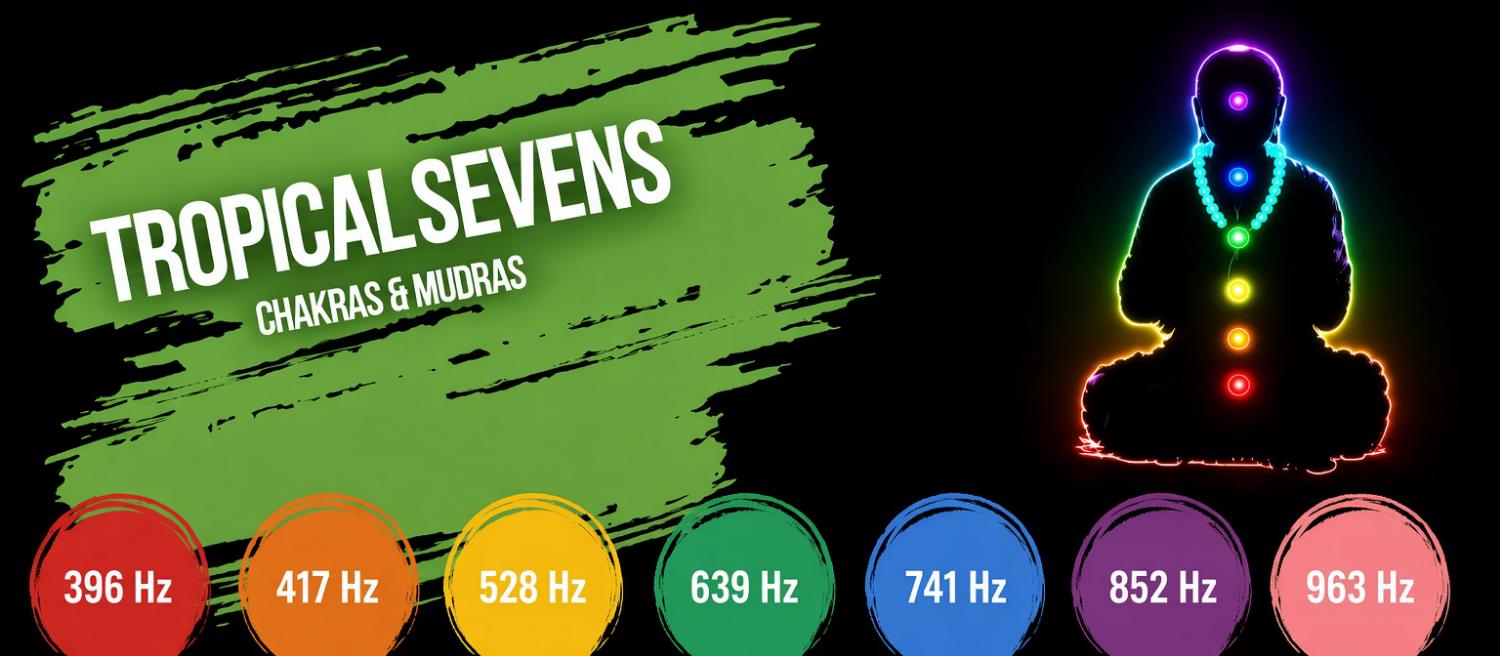
We play one bowl, or several, through the seven chakras, often matching a Solfeggio frequency to each center. You rest. You do not have to perform healing. The water does some of the work.
- Intention first. Before a session we name, quietly, what the water is being asked to remember — safety, flow, fire, love, truth, vision, or rest.
- Then the tone. A bowl is played at or near the frequency of that center until the room itself seems to hum.
- Then silence. Emoto froze the water to see the crystal. We sit in the after-sound so the body can keep the shape.
Solfeggio
Play the seven tones
These are singing-bowl-like voices generated in the browser at each chakra's frequency. They are not a substitute for a live bowl — they are a way to meet the pitch today. Use headphones if you can, at a modest volume.
Root · Muladhara
396 Hz is the Solfeggio tone of liberation — it is used to loosen guilt, fear, and the feeling of not belonging on the earth.
Sacral · Svadhisthana
417 Hz is the tone of change — it is used to dissolve old emotional weather and make room for a new current.
Solar Plexus · Manipura
528 Hz is called the miracle tone — transformation, repair, and the return of personal fire. We use it to warm the will.
Heart · Anahata
639 Hz is the frequency of connection — it is used to restore harmony in relationships, including the one with yourself.
Throat · Vishuddha
741 Hz is the tone of expression and clean solving — it is used to clear the channel so truth can move.
Third Eye · Ajna
852 Hz is the tone of inner order — it is used to clear confusion and return vision to the one who is looking.
Crown · Sahasrara
963 Hz is the frequency of oneness — it is used to remember the quiet above thought, the thousand-petaled lotus.
What a sound bath is like
You lie down or sit. The bowls are played around you — sometimes on the body, always with consent. There is no choreography you have to follow. Some people sleep. Some people cry. Some people simply notice that the jaw has let go. Afterward there is water (blessed, if you like, the way Emoto would have it) and a few quiet minutes before you stand.
Sound healing is a wellness practice. It is not a diagnosis, a cure, or a replacement for medical or mental-health care. If a tone feels like too much, stop. The body is the first teacher.